
Arriving at The Dales Countryside Museum with my ‘shopping list’ of questions didn’t seem to faze the wonderful Ben or Fiona at all to my surprise!
“Have you got something Bronze age round the Semerwater /Countersett areas? “
“Yes ,we have!”
To be privileged to have access to the archive and get close up and personal with something someone in the bronze age made , used and lost I found profoundly moving and very humbling. The detail and skill of the maker of the bronze spear head, left perhaps as a votive offering , the delicacy of the flint arrow heads beautiful and lethal and the shard of pottery , beautifully inscribed with a pattern. Each held by human hands 4,000 years ago .
Seeing these got me thinking about how these items were actually used.
In Linda Hurcombes book, Perishable Material Culture in Prehistory, Investigating the Missing Majority, she explains that birds were used in a variety of ways in society which we know, not by direct ‘finds’ ,but by experimentation of replica tools .She began to realise the relationship between the tool for getting food or making things meant a relationship with plants and animals which, being organic , did not survive and these perishable materials told of landscape and place.
Ancient people would have used locally found nettles or other plants for fibres as well as wool, used locally sourced wood for building and other tools, eaten a locally sourced diet. It stands to reason that the ancient peoples would have heard and seen birds on a daily basis, marked seasons by them, marked navigation routes by them eg Raven Crag or had close relationships with birds like sparrows and starlings that optimised the early farming and homesteads as food providers.
Coppicing of trees , i.e. cutting down hazel to its base or ‘stool’ would have been observed to regrow over several years and in this time different plants would have opportunity to grow and birds to utilise more open areas, an example we can still see today in Freeholders wood, Aysgarth. This ‘tending the wild’ , a phrase used by Kat Anderson ( 2005), would have meant a close knowledge and management of local resources – which obviously changed over time due to changes in population, climate, land ownership and political /national initiatives. Birds would have been intimately part of this .
Animals and birds have had totemic relationships with humans as they were attributed some agency. They were seen as metaphors or mythological beings. The use of bright feathers as part of clothing adornment could have been used to invoke some element of the bird e.g. eagle feathers to represent a skilled hunter, keen sighted, respected, feared maybe – a leader? Our ancestors would have had detailed knowledge of their environment and the birds ( and animals) within it – gathered from keen observations in the environment they knew well. This was human survival and knowledge meant favouring success.
Probably one of the most common uses of birds , apart from food, was to provide feathers for arrows - good quality feathers to use for fletching needed to be sourced through trial and error and be able to be attached safely and securely and from a plentiful and reliable source.
Successful hunts with well fletched arrows might have taken the bird providing the feathers to some more symbolic role within the society. Emblematic of good hunting.
Bird bones have also been found to be used to make impressions into pottery to decorate clay pots and vessels.
Petroglyphs, prehistoric rock art, rarely depict birds. Cresswell Crags on the Derbyshire/Nottinghamshire border, have the UK ‘s only 13000 – 15000-year-old art, more remarkably which has a bird panel which seems to show an Ibis or wader of some kind with a curved beak.
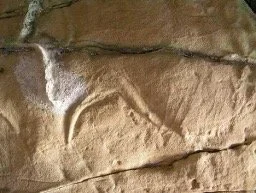
Paul Bahn, Francisco Muñoz, Paul Pettitt, Sergio Ripoll. 2004. New Discoveries of Cave Art in Church Hole (Creswell Crags, England). AntiquityProject Gallery78 (300)
https://antiquity.ac.uk/projgall/bahn300
Robert Montgomerie in his 17 Oct 2025 https://bou.org.uk/rock-art/ article suggests that “
Birds are much more common in petroglyphs and paintings found on rock walls that are visible with natural light and do not involve crawling deep into subterranean caves. “
In one example from Spain containing 200 bird images, “identifiable as bustards, geese, ducks, spoonbills, ibises, coots, gallinules, herons, egrets, cranes, flamingos, avocets, stilts, harriers, and vultures (Lazarich et al. 2019).” He suggests that all the species are big enough to be useful food items and images of hunters with spears seem to support this.
Montgomerie suggests:” the petroglyphs and paintings on exposed rock were not there for magico-religious purposes but rather as a pre-writing and pre-hieroglyphic form of communication that would aid other hunters to be aware of the local bounty.”
So, our dales birds ,although we might not have got any direct detailed local evidence, exsisted through time when in other parts of Britian, they were drawn in caves and had some relationship with humans.